Wednesday, May 04, 2011

Diamonds on the soles of their shoes

I think that tonight i came up with a juicy strategy for staying in a centered, present moment state at work.

I was telling a friend how much I want - starting with tomorrow morning's shift - to find that flowing, peaceful state while I'm running the cash register. I knew what it looks like to be in that state, but at first had no clue as to how more to get there. Then out of nowhere a method presented itself: "I want to like them." Yep, I want to practice - as much as possible - liking each person as they come through my line. This focus outside of me can, I think (we'll see), pull me out of my self-preoccupation and get me to show up in the moment.

Then my friend made a suggestion that made this strategy more concrete and tangible and specific - that I think will make it easier to operationalize. She suggested I see my customers as having diamonds on them. Appreciating and liking them can be like harvesting the diamonds that they are wearing from the soles of their shoes to the top of their heads.

I can hardly wait to try this tomorrow.

The zen of cash register

I've been cashiering in this Whole Foods grocery store for about three weeks and am just now getting comfortable enough with the idiosyncrasies of this particular cash register system - and remembering just enough of the four- and five-digit codes for coffee, hot bar, muffins, bananas, etc. - to start to relax a bit and to have some attention free to focus on the people coming through my line.

Sunday and Monday I was in a good mood when I arrived and then really mostly had a good time. I was able to manage the cash register and really show up for my customers. I got into a flow - even a kind of zone - where each transaction in these very busy shifts stood on its own, with no carryover from the previous one nor anxiety regarding the people waiting in the line. This made it easy and fun.

Tuesday I was not in a good mood when I arrived. I was still aggravated from an upsetting encounter with my roommate the night before. I was enough preoccupied with this unfinished business to not be able to drop into that peaceful zone with my customers. In this off-center state, everything was difficult: running the cash register was hard and dealing with the customers was flat and awkward. And then I judged myself harshly for "not doing a good job" - and this just made everything harder.

I realized near the end of my shift that in my aggravation with my roommate - my conviction that she had screwed up and was a jerk for doing so - I had taken up residence in a world where things go wrong, and especially where people can be wrong. Inhabiting that world, I saw things going wrong at work - and especially saw myself as wrong. As I closed up my register, I was convinced that my drawer would not balance and that I would lose points over it. Seeing this reaction really nailed it for me: "Yup, I'm in the world where things go wrong and where you get in trouble for being wrong."

I'm grateful for seeing this so clearly - and for having a job that right now seems to provide clear and immediate feedback about my internal state. When I am centered in the moment, it's fun and easy; when I am off-center, preoccupied, not in the moment it all gets hard and stressful. Now to find ways to move into that more centered, here-and-now state.

Sunday, March 29, 2009

"Watch me work!"


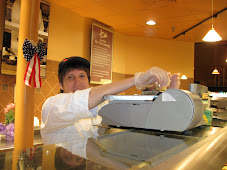
The woman in the Earthfare deli had no problem with me taking her photo. But she said, "Don't just take our pictures - buy something from us so we can show you the kind of customer service we really can provide."

More fun

One sign that a team is really clicking is how much fun they are having.

In one retail job at a large gift shop, there were as many as five of us at a time working next to each other in one long bank of cash registers. One of the real challenges was how much you could mess with your neighbor's work station when they momentarily stepped away (or, even more challenging, when their heads were turned): steal their pen, toss a wadded up piece of paper into their work area, hide their phone behind the cash register - it got harder and harder to stay creatively messy, but we worked at it.

Our cash registers were actually fairly sophisticated computers. One day i returned from my break to find my mouse so wrapped up in bubble wrap and scotch tape that it took about three minutes to extricate it - and, when i got a couple of customers as soon as i came back on, i had to try to make the mouse work while it was still in its little nest. My coworkers watched the whole show and only barely managed to hide their delight.

One day i was playing trick after trick on Peggy, who worked the sales floor. After one especially creative little tease, as she walked by my register i just beamed with how pleased i was with myself. She turned to me with a look that was equal parts fun and menace as she said, "It's not over yet." It was one of the funniest and sassiest and coolest things i have ever heard a co-worker say.

Internal customers

Good supervisors and managers know that the folks they supervise or manage are also their customers. These front-line folks also need to be served - with information, support, guidance and (perhaps most important) acknowledgement.

When i worked one holiday season as a "retail sales associate" (shop clerk) in a large gift shop at the Biltmore Estate (Asheville's largest tourist attraction), the supervisors and managers in the retail departement seemed to understand this. They treated the front-line folks like gold. And it worked: it was then easy and natural for us to treat each other well - and to treat our customers like they were gold.

Being acknowledged


Business was slow at the pet supply store and Melanie looked like the hours were weighing on her. But a little attention from a guy with a customer service business card and a camera brought her back to life.


I really like the store where she works, but i wonder how much cheerleading she has gotten recently from her supervisors. When i treated her like she was interesting and valuable, she responded as if that was exactly what she was needing that afternoon.

Attitude


Chris at the CVS drugstore was from the start very engaging, but really lit up when i gave him my business card with this blog on it, asked him about his job and asked permission to take a photo.


"Sometimes I don't really look forward to coming in for 12-hour shifts like today. But attitude makes all the difference in the world: if i'm determined to make it a good day, it is one."


While i do agree with the whole FISH customer service tenet of "Choose your attitude", i also think it's over-rated. it puts, for me, too much responsibility on the server and leaves out all the systemic factors that influence a worker's ability to "choose a positive attitude".


But Chris was a gas - and a showman.

Sunday, August 03, 2008

Customer service as improv

Sometimes, when a customer has even a very minor transaction with us, they like to make just a little bit of small talk. And sometimes, when they do this, we have absolutely no idea what the hell they are talking about. And, to whatever extent we can figure out what they are talking about, we may absolutely not care.

This morning in the hotel gift shop where I’m a cashier, a guy was buying AA batteries. He was a little taken aback by the price of hotel gift shop batteries, but recovered by telling a little story about batteries:

“You know, I saw a thing on TV the other day, where they took apart a regular 6-volt battery – and there were about 32 of these little AA batteries inside it.”

“Wow.” (“What? What’s a 6-volt battery? It feels like once upon a time I knew. Why is he telling me this?”)

“So, a 6-volt battery costs about $8 – and it has about 32 of these inside.”

“32?!” (“Oh, he really still is complaining about the cost of these batteries.”)

(As he walks towards the door.) “Yeah, it’s got me wanting to take one of those 6-volt batteries apart and see what really is in there.”

“Yeah, now you’ve got me curious.” (“What’s a 6-volt battery? This guy obviously has too much time on his hands.”)

So, was my little conversation with this customer “authentic”? On one level – the content level – obviously not. On the content level, my few words to this guy were about as full of B.S. as you can get.

But on another level I was completely authentic: I wanted him to go out the door of my shop feeling good – good about the little conversation he just had, and good about himself. There were a variety of things I could have said that would not have had the desired effect of him walking out feeling good (not including ones that would probably have gotten me fired).

Or I could have just stared at him blankly – a response I have experienced many times from cashiers when I have tried to make small talk.

In the world of comedy improv, they talk about the “Yes, and…” principle: you take what the other person hands you and try to do something with it. If the other person, with no prop in their hands but thin air, makes the gesture of literally handing you something and says,

“Man, this coffee pot is hot – ouch!”, you might say things like:

“Oh, man, this is hot – think I’ll put it on this table over here.” Nothing funny here yet, but it keeps the scene going. Or,

“Yeah , how did you afford a gorgeous new high-tech coffee pot like this? Ouch! Oh, man. Wow, look at the interesting pattern that coffee makes on the beige carpet. Boy, you brewed it strong today.”

You could say clever things that might get a quick laugh, like “That’s not a coffee pot, it’s a beaver - he’s cute” or “What? You don’t have anything in your hands” – either of which leaves the scene with no place to go and your fellow scene-player feeling completely helpless (and betrayed).

So, what does all this have to do with good customer service? If you want to offer exceptional customer service (and make your own day go faster and be more fun), you learn how to take whatever the customer hands you and do something with it – preferably something that leaves them feeling listened to, valued, interesting. You don’t want to give them some awkward or disinterested response that leaves them feeling awkward or stupid or irrelevant or boring.

While I enjoy making my own little jokes, I value much more highly cracking up over my customers’ jokes. Most customers love it if you play with them. I want them to feel funny, clever, witty – which they often are.

To do this requires being flexible and on your toes. Even if you have (in a store that is not real busy) been completely daydreaming or pouring your attention into your laptop computer (one of the perks of working for peanuts in this hotel gift shop is that I actually get to do this), you need to jump to and not only give your total attention to this customer, but be ready to really engage with them.

“What kind of response would I want in this kind of situation?” And, generally, interested is the baseline.

One day at my cashier job in a gift shop at the Biltmore estate, this old farmer guy – there on a tour and looking hopelessly awkward and out-classed by the lavish surroundings – started telling me about his farm. I know at least as little about farming as about 6-volt batteries and did not understand most of what he was saying. But I kept paying really good attention and responding as if what he was saying had real importance and dignity – which it did. When he reached his huge hand over the counter to shake mine and to so-sincerely thank me for listening, I imagined that his weather-beaten eyes were almost moist. Mine were.

If the customer has, for whatever reason, begun to pour out some story about how frustrating their trip was – or about their dying mother that they have come to visit (I actually got one like this), then jocular or simply attending won’t work and you have to go to empathetic – even if semi-sincere is the best you can muster:

“Oh, I’m sorry.” (“Why the hell are you telling this to a cashier?”)

Either of these requires that you be quick on your feet – and paying really good attention to whatever that customer presents.

Or you can look at them like you are simply waiting for them to get the hell out of your store, so you can go back to telling your co-worker what happened on American Idol last night, or back to your daydreaming or solitaire on your laptop.

Sunday, March 11, 2007

Just corporate enough

About a year ago, I was working two part-time jobs. The first was staffing the gift shop in really a fairly nice, big downtown hotel. The second was as a cashier in a very busy gas station.

The first was obviously quite a bit classier, but – after about four months of juggling the two – I quit the gift shop to go full-time at the gas station. One reason was economic: they both paid a pittance, but six days at the gas station meant eight hours of overtime, which never happened when I split my time between the two.

The second reason I described as that the gas station was “more fun”. By that I meant it was looser. Paul and I, the primary worker-bees, each felt free to kid around with customers – especially our many “regulars”, but not just them. With the guys, we used lots of what I call “buddy”isms – “man”, “guy”, “bud”, “buddy”, etc. Not being southern, I had a little more difficulty with terms of endearment for women customers, which flowed easily out of Paul – “hon”, “dear”, “sweetie”, etc. But, somewhat to my surprise, after a few months, the occasional “hon” just popped out of my mouth, unbidden. A couple of my favorite regulars even sometimes got a “darlin’” – again, pretty much to my surprise, but it also felt really natural.

I’ve written at length about how sweet those interactions could be in “Keeping It Human”, an “Article” at my Authentic Customer Service web site – (see adjoining link). I also wrote about how satisfying it was to sometimes not be so nice, when the situation warranted.

I now have left the gas station (more about this in an earlier post) and am again doing 2-3 shifts a week back at the hotel gift shop. Returning there after almost a year away, I have observed three things about this job.

1. Working in the hotel (though I am not a hotel employee - my boss is the guy who leases the gift shop) is more conservative, more corporate. Whereas at the gas station you were usually alone and free to basically create your own little culture, here there are lots of other watchful eyes, including various managers who somehow feel it is their responsibility to watch over what is going on in the gift shop.

2. I’ve learned a lot in the intervening year about being a “host” – partly from working at the gas station, where I really did consider people “my customers”, but also from watching other folks who are good at hosting in a retail environment. (See my post about Khawla, the manager/host at our downtown drug store.)

3. I’m having way more fun this time around. Having played so much with my customers at the gas station, I seem able now to feel my way into just what are the boundaries of fun here in this more corporate hotel. I don’t use near as many “buddy”isms – and so far no “sweetie"isms. But I have let loose with a few “man”s. Somehow I have an intuition - so far accurate, I think - of with whom this relative looseness could work. A couple of these guys may have been a little surprised by my familiarity, but hey, this is Asheville – my orthopedist calls me “Man”.

But the looser modes of address are just the tip of the fun iceberg (definitely the wrong metaphor). I am just looser with people in general. I know it comes through in my tone of voice. I’m liking myself more and liking them more.

I think I’m shaking the job title of “Cashier” or even “Sales Associate”. I’m not just a host, but I’m more than ever a person – who just happens to be playing the role of “Cashier”, etc. I am meeting people, more than ever, person to person. As I do that, I can more just sense to what extent that person or family is ready to have fun – and I, these days in this job, am almost always ready.

The other day, one of two 12ish girls, themselves clearly having fun roaming the hotel, said, “You’re cool, John”. I think she liked the full way I showed up for them - like they were real people, not just kids. And I think she heard the subtle playfulness in my voice. I responded with, “Great. Come on back and we’ll hang.” They clearly loved that – and did breeze by several more times that day, giving big waves and an occasional, “Hey, John”.

A 12 year old girl clearly having a good time with a 60 year old man who isn’t her grandfather - it can’t get much more fun than that.

Thursday, March 01, 2007

Getting Canned

I guess I picked a good day to die. That woman last night was so fundamentally disrespectful that I mostly don’t regret calling her a bitch. If she had been a little less nasty, if I had been a little less angry, I might have come up some more elegant response, but I really was not able to sort through my options at that moment. I think I might like to have stood toe-to-toe with her and said something like, “Do you know how completely disrespectful you are being? This is totally unacceptable.” And then to have found some good way to respond to what she threw at me next.

As it was, I think I knew I was abut to blow from the extraordinarily hostile way she said, “Oh, so I get delayed because you screwed up”, so moved away from her quickly, dropping behind me as I went my typical sarcastic/harmless, “Thank you, have a nice day.” I really did not intend to have her hear my “bitch”, muttered under my breath, but she did.

She came over to the booth then, her aggressive tone undiminished. “What’s your name?” “John…you weren’t supposed to hear that.” (I don’t know what good I thought that might do.) Her following words were ok in themselves, it’s just that they were delivered with the same icy aggressiveness. “It’s not professional to call someone a bitch.” I might have gotten away with it all (she might have cooled off and not called HQ), had I not then said, “Sometimes it just fits.”

Like I said, I’m not going to second-guess myself. I did what I did, and mostly I’ll stand behind it. And I have known for the last few weeks that I was overdue to get out of here. The late nights play hell with my body and mind. And the repetition of the interactions has finally reached a point that I finally can’t find my way around it any more. So life helped me unhook.

Jim, my boss, was so nice about it: “It could have been any of us.” His boss had said to him, ‘I’ve been letting too much slide at your store. Not this time.” I expressed to Jim my primary concern about the loss of my good reference. He said, “Have them call me.”

Paul was totally understanding and playing to the light side, “You bad boy…I was lucky to slide through.” Really very nice connections with both of them. I meant it when I said that I will stay in touch. And I agree with Paul that, “When one door closes, another will open up.”

I liked saying to Jim – and even clearer to Paul - how nice it has been working with them, and what exceptional men I think they both are. Paul made it clear that he felt the same.
So, overall, I’m not feeling very bad, considering. I actually am glad to have gone out with a bang, not a whimper.

Mike

Mike is my third colleague at the gas station. He’s the newest here, but he has done a lot of this work over the last few years. Mike is clearly burned out from this work – as is Paul, and as I am more and more becoming, after a year at it.

Mike’s way of handling his burnout it to keep his energy tightly held in, to extend as little as possible to customers. One day he said to me, “My policy is to interact with these people as little as possible. I take their money and give them their change. Otherwise, they’re on the other side of the window and I’m going to keep them there.”

He is not totally consistent about this policy. Some people come in that he knows – either from other jobs or from here – he will be friendly and goof around with them. And clearly – maybe he’s in a good mood – something motivates him to be friendly or nice with some other people. But otherwise he is just amazingly flat – his voice is frighteningly dead. “Yes, ma'am”, as if he was dealing with something other than a human being. The other day, a cute little girl, maybe all of six, came to the window, bringing up her mother’s gas money. “Surely he’ll give her a little extra juice,” I thought. Nope. The same – just “no ma’am”.

Mike also has some choice labels for our customers, like “crackheads”. There certainly are some crackheads in this neighborhood. (A twentieish girl came in one day to retrieve the drivers’ license her mother had left. “She’s a crackhead – always has been, probably will be until she dies.”) So he may sometimes be right. But I don’t know how he can tell in each case.

(I also mostly don’t like the word. It feels pretty disrespectful. Even the more simply descriptive “drug addict” leaves out so much of who they are. Drug addiction is not who they are, but something the do, or are struggling with.)

Mike obviously thinks that he is somehow protecting his energy by relating to people in this distant sort of way. But I don’t think so. I think he’s killing his energy, and – at least a little bit – himself. There’s a way that treating other humans as if they were something less – even if we call them “customers” – takes away some of our own humanity.

Paul has done this work longer and is, also, clearly burned out. When he comes in to start his shift, he makes no bones of the fact that this is one of the last things he wants to be doing, but has to because he needs the money. Or, when I relieve him, he always says that he is “real glad to see you”.

But Paul handles his burned-outness in a very different way than Mike. He has a little game he plays with almost every customer. No mater what they ask for (“$20 on pump 4”), he says “No” – but with such a sweet little lilt, almost singing it, that people know he’s teasing. Some of these customers (usually young women, for some reason) will playfully sass him right back, saying, “Yes”, very definitively. But almost all seem to enjoy it.

(Not all – some just look at him like he’s speaking Greek. He shrugs it off, saying, “He didn’t get it.” And it does no harm and is just a little price from taking a little risk with people. I have worked in a couple of buttoned-down corporate retail situations where this kind of playfulness absolutely would not have been allowed. I actually got fired from one for just this kind of banter with a customer – who did “get it”, but the manager did not. Here, our manager does get it, and appreciates the way Paul is giving a little something extra.)

It doesn’t matter that what Paul is doing is not really creative or truly spontaneous, since he does it with almost every customer, for the whole shift. But still, he is injecting a little extra energy and people feel, I think, like they have been acknowledged.

Sunday, January 28, 2007

James

James is the manager of the wine store across the street from where I live. I had been thinking that I might want to work as a “Wine Tasting Host” at a local resort that has its own vineyards, so I decided I should drink more wine (work, work, work) and try to learn more about wines. So I went over to the wine store and tried to get some information.

I told James what I was up to. I asked him to describe to me the differences in two wines that were on sale – both quite reasonable at about $8 – and then picked one to buy. I would not say that James was unfriendly – just that he was not friendly. (The contrast with Kawla, in the previous post, was extremely striking.) He stayed very aloof, answering my questions, briefly, but making no attempt to really engage with me.

I walked out of the store feeling almost like I had dirt on me – I not only did not feel valued in that store, it felt that I had been disrespected, really kind of devalued. This whole thing felt so yucchy, especially in Asheville, a town where people do generally tend to be informal, friendly and engaging (the orthopedic surgeon who operated on my shoulder calls me, “Man” – I love that). The whole experience felt kind of strange – I was actually a bit blindsided by it.

So I found myself trying to make sense of what had just gone on – partly so as to not take it personally, even when it did feel kind of personal. Here were my hypotheses:

1) James knows lots about wines. He was offended by the very idea that a store could hire someone, teach them some minimal amount about a limited stock, then turn that person loose like he really knows about wines. This is actually my favorite hypothesis. I can kind of understand it and it mostly does not feel personal. But I keep finding myself thinking that this was not all that was going on.

2) James’ customers tend mostly to be pretty affluent. They come down from their mountaintop retirement homes – or second homes – and stock up on wine. I see lots of folks coming out of there carrying cases of wine or followed by one of the staff carrying one or more cases. Not only was I clearly not going to be buying cases of wine, I actually walked out with one of the cheapest bottles in the store. I didn’t tell James that I could maybe afford one such bottle per week, if I pinch my pennies, but he may have guessed that. So he smelled that I was not going to be much of a customer. Thinking about it this way feels more offensive than #1. But #3 feels the worst.

3) This whole encounter reminded me that wine, in our culture, is interwoven with class. Wealthy people buy good wines. Students, blue-collar workers, etc. either drink beer or inexpensive wines – cheaper than anything in that store. I’ll bet that even lower-middle class folks, if they do go in this store (or the resort winery I referred to), tend to feel a little awkward, a little out of their element – a little outclassed.

As I walked away from the wine store, I couldn’t shake the idea that James’ cool response to me probably had some of all three motivations. 1) He believed that “wine tasting hosts” should know a lot more about wine than I could possibly learn in some little training program. 2) He was not motivated to invest much energy in someone who was never going to be a particularly high-dollar customer. And 3) he likes to spend time with affluent, higher-class customers – and did not, actually, value me as much as them.

These hypotheses – made up in my head as they were, without good solid data – left me feeling soiled about the whole wine business. I no longer want to work as a “Wine Tasting Host”. Once in a while I may buy a bottle of wine, especially – let’s face it – on a date. But I think I’ll mostly just go back to beer.

Khawla

Khawla is, I guess, the “manager” of a local independent drug store. To me, she is the “Manager of First Impressions” or, even more, a gracious hostess.

At work, Khawla (who grew up in Palestine) mostly uses the name Kathy, I imagine because it is easier for our American ears and tongues. I have this belief, though, that one very fundamental way of respecting people’s various diversities is to call them the name they would like to be called. I also think that we Americans tend to be kind of provincial in the way we get cranky if someone has a name that doesn’t come easy for us. So what – get over it. So I asked Khawla if Kathy was her given name (I suspected not). When she told me that her given name was Khawla, I asked her if she would like me to call her that. I thought she seemed pleased as she said, “Yes”.

Khawla’s drug store is in many ways outclassed by the “Big Box” drug stores. Their stock is mostly just medications and low-priced cigarettes (kind of ironic) – and not much beyond that. But they are the only pharmacy downtown and they are s-o-o nice. All the staff are nice, but Khawla is the queen of nice. It actually goes way beyond nice – Khawla makes you feel that you are a valued guest in her store.

Yeah, lots of restaurants, retail stores, etc., are picking up on the “guest” language and metaphor. But for Khawla it is neither an affectation nor a gimmick nor a metaphor. That’s just how she thinks about it. I mentioned this observation to her one day and she responded – with obvious sincerity – “That is the way I see it. Most of our customers are also very nice, so I am happy to see them come in.”

Another thing that seems significant about all this is how many of Khawla’s customers are poor and/or disabled. They live in rundown and/or subsidized housing downtown and don’t have cars to go to any of the more glitzy stores outside of the city center. These are folks who are often marginalized or devalued. Khawla treats them all with equal graciousness. If she even sees that the customers are poor, disabled, etc., she shows absolutely no sign of it in her manner.

I wondered if any of Khawla’s gracious manner stems from her cultural background. I asked her the other day and she said, "I think so - to respect each person for who they are." This is not something I knew about Palestinian culture - I am glad to know it now.

Jimmie

Jimmie is one of our goofiest customers. He is 70’ish, dressed typically in a dirty t-shirt, poorly or unshaven, scruffy hair. He drives a very old, very beat-up truck that you can hear coming before it pulls into the lot. No one in his family, including their two grown kids who live at home, can ever afford to get very much gas at one time, so we see them at the gas station one or (often) more times a day.

Jimmie is prone to making the same tired little jokes

· Ordering his cig’s, “Give me a pack of them lung-busters.”
· Asked how he’s doing, “I’d say I’m pretty good, but I ain’t a bit pretty.”
· Or “The old lady’s gone, so I’m doin’ good.”

He typically has a kind of vacant look about him that leaves me wondering just where he’s really at, anyway? His wife, Ann, seems so much more with it that I sometimes wonder just what keeps them together.

Tonight, Jimmie was at the outside pump, filling up Ann's new-to-her little, relatively less beat-up red car, while she came over to the window to pay. Then, when their car was full, I suddenly saw Jimmie at the pump directly in front of me, helping a woman with a walker who was having a hard time using her credit card at the pump. I asked Ann if he knew this lady – I was sure he must, from the way he went over to help her.

Ann said, “No, she was having trouble, so he went over. That’s how he is. He just can’t see anybody having a hard time without trying to help them.”

Go figure….

Next day: Jimmie comes to the window and I mention him helping that lady.
“Hey, that was really nice of you.”
“Well, she needed help.”
“Ann says you do that kind of thing a lot.”
“Well, you never know when you’re going to need their help.”

So much for “vacant”… how much more is going on under the hood with this guy that his manner does not tip off?

Taking Care of Your Money

Sometimes people pay with bills that have not been well cared for. Sometimes the money has clearly just been balled up in the person’s pockets. I have, more than once, been given a $100 bill that was wadded up not much bigger than a dime.

Now I admit that cashiering has activated a little latent anal-retentiveness in me. When people give me a bundle (even five) of dollar bills, I do wish they were all facing the same way (and my boss requires this of me). I will typically put these disorderly singles in the little basket on the right side of the cash register (away from the window) for later arranging, and take some moments to get the larger bills in their appropriate slots.

But today a guy laid down a little bouquet of rolled up bills and said it was $30. I did take care of myself by saying, “Let’s see what we’ve got here” and then took the time to count it. When people hand me better arranged bills, I will often just eyeball them and not actually count the singles – don’t tell my boss. When I do get around to counting them, lined up the same way, before putting them in the drawer, they are almost always correct. But the chaos of this pile told me I should count it carefully, which I did.

This obviously irritated my young customer. But I realized as he walked back to his car that I really had let him off too easy. I allowed him to get about his business, but I was still faced with that bundle of wadded up bills to be put away, while I had other customers in front of me at the window.

What I really needed to do was to patiently straighten out those bills and put them in the drawer before turning on this guy’s pump. He might then express more irritation – verbally or nonverbally. (It actually occurs to me that this guy really was in a passive-aggressive mode – frustrating him could easily take out the passive part.) I could then have explained, in my most matter-of-fact way, that the money has to go in the drawer before I complete a transaction. I might or might not add, “If you want it to go faster, you need to pay with bills that are in better shape.” (Oh, let’s not. If he’s not catching on at that point, the two-by-four is probably not going to help.)

I feel good about this approach. It’s neither punitive nor arbitrary – it’s simply letting the customer take the consequences of balling up his money.

SMALL TALK

“Small talk” has its own little niche in ACS interactions. It tends to be more engaged than “matter-of-fact” interactions (see previous post), even while it can be ridiculously repetitious, dealing with gas prices, the weather, cars, etc. But it also tends to have less humor and edge than “easy banter” (see previous post).

It’s the kind of interaction that I have at times viewed as “too superficial” or have said that I’m really not very good at it, because “I want real sharing”, or some shit like that.

It is getting clear to me at the gas station that this kind of “small talk” is the lubricant that keeps some relationships, at least (maybe lots of relationships, not just at the gas station) moving along. (In the song “It’s a Wonderful World”, there’s the line that goes, “I see friends shakin’ hands, sayin’ ‘How do you do?’ What they’re really sayin’ is ‘I love you’.”)

I am getting better at small talk – and I am seeing clearly its value. Much of the time, it’s what saves us from just standing there, awkwardly looking at each other. Awkwardness can trigger shyness, which can trigger avoidance. Small talk smoothes things, makes them comfortable. It’s actually pretty good stuff.

Not showing up 100%

I may be especially involved in a book that I am avidly reading when there is even a little break in the action. (Sometimes I just read a sentence at a time, but am so into the book that this is still, for me, worth the effort of going back and forth.) When lots of my energy is going to what I am reading, I have less energy available for interactions at the window, and I am more likely to be simply matter-of-fact with customers who present themselves at this time. It’s easy to make a case that I am then less fully focused on the here-and-now, not giving 100%, even a little like the robot I, overall, do not want to be. But this work can, honestly, be so boring – especially near the end of a shift, when I have already been doing it for several hours – that I kind of need to offer myself the carrot that, when things slow down, especially later in the evening shift, I’m going to give myself the little reward of reading stuff that I am really into. I feel no guilt about, at some time, “showing up” a little less for the work. Offering myself the carrot allows me to feel better about the shift and the job itself. It is part of what allows me to keep going for this shift, in this job

Tuesday, October 10, 2006

CAUTIOUS BOUNDARIES

As I was leaving the gas station today, one of my favorite shy little nebbishy guys came in. I went around to his truck and kibitzed with him about the big honking industrial-strength riding mower on his trailer – he mows lawns for part of his income. I joked about climbing in the trailer and getting a ride. After he pumped his gas and got ready to leave the station, he said, “Climb on in” and I was caught unready when I realized he meant it. I kind of lamely said, “Oh, I’m just going down the street”, but I realized even as I said it that I didn’t know where in me this declining of his offer was coming from.

As I walked down the street to the bus stop, I realized that I actually had no good reason for turning down his friendly offer. He obviously enjoys all our little interactions, so I think he would have been tickled to give me a ride. And I’m limping a little today from a bruised foot, so a ride really could have been helpful to me.

So why did I turn it down? Some of it felt like my old psychologist “professional boundaries” – like it would have been somehow crossing some line that would be improper to cross. But it’s been 20 years since I did that kind of work, and my intervening management consulting work had way looser boundaries. There was every good reason to be more of a friend with these clients.

But this is a gas station, for god’s sake. Why the hell am I talking about professional boundaries?! Partly for the same reason that drove also some of my psychologist boundaries – to keep myself safe. I have since had a therapist who, after she has known a client (like me) for a good long while, has – in certain instances, like with me – developed very good friendships with them. Part of me still kind of wonders how she does it, but she does - and it works, for her and for me and for at least one other now mutual friend.

So what am I trying to keep safe? Mostly the same stuff that drives excessive caution and control wherever these pop up in my life. I feel like I have stuff to hide, that I need to keep my persona (the self I present to the world) pretty solid, unshaken by too much spontaneity. Standing behind the gas station window, I have a role that makes it safe to be relatively spontaneous. Out on the same side of the window as my customer, I don’t quite know how to behave. I don’t trust that just “real” and “human” will be enough.

I don’t want to make too big a deal of this little interaction. No real harm was done. David may have felt just a little rebuffed and disappointed, but I doubt very much so – and there will be lots more opportunities to express that I like and value him. And, as I waited at the bus stop, another of my favorite customers came along and I got to have a nice little visit with him – which totally indicated to me that there was no mistake, that everything was just as it was meant to be.

But I like the little bit of reflecting I have done here about “cautious boundaries”. I think that next time I might like to observe my inclination toward caution and control, and perhaps have a little more freedom to act from a more truly conscious, more flexible place.

Tuesday, October 03, 2006

FRIENDLINESS EXTENDED

I have written elsewhere about customers who, even though they may be regulars, never leave an opening (as I experience it) to go beyond a pretty purely business interaction. I have written also about those times when, for a variety of reasons, I don’t reach for anything more than a “matter-of-fact”, kind of minimal encounter.

There is a whole separate category of encounter, with people who never come to the window. I more and more find myself extending friendliness – even if only a “Hey” or “Have a nice day” - to these folks. They sometimes initiate a verbal exchange (they say “Hey” or something). Or they meet my eyes in a way that opens a space for engagement. Or if they don’t really make eye contact, it is still relatively easy to reach out to people who are looking in my general direction. But even people to whom I extend as their back is to me, as they are getting back in their car, generally seem to appreciate it.

I’ve always been a big extrovert. When my son, who is an introvert, was a teenager, he had big problems with my tendency to greet strangers out on the street – even in Chicago, where there is lots less of this random greeting than in his Louisville, KY – and way lots less than in my current Asheville (where we say “Hey”, not “Hi”).

His protests were mostly variations on “Why, why did you have to talk to that person?” One time, prepared for his challenge, I playfully said, “He started it – he looked at me first.” But the response that most drove him around the bend went:

“Because he’s my brother.”

“What?!!”

“Yeah, all other people are my brothers and sisters.”

A disbelieving look, like I had finally, totally lost it.

But some of these gas station greetings have been a stretch even for this extrovert, especially when they are not true encounters. If we are not passing by each other, if our eyes do not even come close to making contact, what is the basis of extending friendliness in their direction?

One explanation I give myself is that they are our guests at our store and I am just being a good host. We don’t refer to our customers as “guests” in this gas station, as we did at a restaurant where I used to work as a server, but the concept does work for me in this environment.

But the rationale that works even better for me is that they are fellow human beings - that same brother/sister riff. I really do buy this.

A few years ago, I went to two silent meditation retreats in the same summer. Each of these retreats broke up the sitting meditation with walking meditation, in beautiful natural surroundings.

At the first retreat, we were encouraged, when we encountered each other on the walking paths, to make deep eye contact, fold our hands and make a slow, deep bow to each other, then more sweet eye contact before we disengaged and moved on. We weren’t told to think the word “Namaste” – “I greet the divine being in you” – but it was like that.

At the second retreat, we were instructed to keep our focus totally inward and to completely tune out our fellow meditators whom we passed by. That approach, especially after the previous retreat, really didn’t work for me. So, while on the outside I was following the protocol, inside I greeted each person I passed: “Hi, brother”, etc.

So, it’s something like this when I go out of my way to greet or wish a nice day to our customers who have not come to the window. I really, mostly do believe that these are both brothers/sisters and essentially divine beings crossing my path – and it feels right to greet them.

And the proof is in the pudding. Pudding proof #1 is that this “extended friendliness” just feels more and more natural to me every day. Second, it seems to work with my customers. Even those who seem taken just a little off balance by an unexpected greeting, mostly smile and seem pleased to be acknowledged. (I obviously can’t know exactly what makes them smile. They could actually be chuckling over this goofy cashier and thinking, “Why, why did he have to talk to me?” But I don’t think so.)

I doubt that anyone would have described me as an unfriendly person, really ever in my life. (I do definitely have my moments, both at and away from the gas station.) But my work at the gas station is teaching me how to extend friendliness, comfortably, in mini not-real-encounters that were out of my comfort zone even a few months ago.

Working at the gas station is making me a friendlier person.

Sunday, October 01, 2006

LATINO CUSTOMERS

These days, when there is so much anti-Latino backlash, I try to give special props to my Latino customers. My Spanish is feeling just too rusty to use (I do want to brush up on it). But, for now, I just put a lot of juice into greeting them – to really, really welcome them. I want them to go away feeling recognized, valued – like, “Hey, he really likes Latino people.”