Sunday, March 29, 2009

Attitude


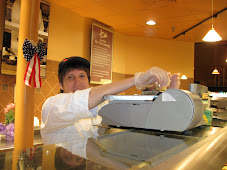
Chris at the CVS drugstore was from the start very engaging, but really lit up when i gave him my business card with this blog on it, asked him about his job and asked permission to take a photo.


"Sometimes I don't really look forward to coming in for 12-hour shifts like today. But attitude makes all the difference in the world: if i'm determined to make it a good day, it is one."


While i do agree with the whole FISH customer service tenet of "Choose your attitude", i also think it's over-rated. it puts, for me, too much responsibility on the server and leaves out all the systemic factors that influence a worker's ability to "choose a positive attitude".


But Chris was a gas - and a showman.

Sunday, August 03, 2008

Customer service as improv

Sometimes, when a customer has even a very minor transaction with us, they like to make just a little bit of small talk. And sometimes, when they do this, we have absolutely no idea what the hell they are talking about. And, to whatever extent we can figure out what they are talking about, we may absolutely not care.

This morning in the hotel gift shop where I’m a cashier, a guy was buying AA batteries. He was a little taken aback by the price of hotel gift shop batteries, but recovered by telling a little story about batteries:

“You know, I saw a thing on TV the other day, where they took apart a regular 6-volt battery – and there were about 32 of these little AA batteries inside it.”

“Wow.” (“What? What’s a 6-volt battery? It feels like once upon a time I knew. Why is he telling me this?”)

“So, a 6-volt battery costs about $8 – and it has about 32 of these inside.”

“32?!” (“Oh, he really still is complaining about the cost of these batteries.”)

(As he walks towards the door.) “Yeah, it’s got me wanting to take one of those 6-volt batteries apart and see what really is in there.”

“Yeah, now you’ve got me curious.” (“What’s a 6-volt battery? This guy obviously has too much time on his hands.”)

So, was my little conversation with this customer “authentic”? On one level – the content level – obviously not. On the content level, my few words to this guy were about as full of B.S. as you can get.

But on another level I was completely authentic: I wanted him to go out the door of my shop feeling good – good about the little conversation he just had, and good about himself. There were a variety of things I could have said that would not have had the desired effect of him walking out feeling good (not including ones that would probably have gotten me fired).

Or I could have just stared at him blankly – a response I have experienced many times from cashiers when I have tried to make small talk.

In the world of comedy improv, they talk about the “Yes, and…” principle: you take what the other person hands you and try to do something with it. If the other person, with no prop in their hands but thin air, makes the gesture of literally handing you something and says,

“Man, this coffee pot is hot – ouch!”, you might say things like:

“Oh, man, this is hot – think I’ll put it on this table over here.” Nothing funny here yet, but it keeps the scene going. Or,

“Yeah , how did you afford a gorgeous new high-tech coffee pot like this? Ouch! Oh, man. Wow, look at the interesting pattern that coffee makes on the beige carpet. Boy, you brewed it strong today.”

You could say clever things that might get a quick laugh, like “That’s not a coffee pot, it’s a beaver - he’s cute” or “What? You don’t have anything in your hands” – either of which leaves the scene with no place to go and your fellow scene-player feeling completely helpless (and betrayed).

So, what does all this have to do with good customer service? If you want to offer exceptional customer service (and make your own day go faster and be more fun), you learn how to take whatever the customer hands you and do something with it – preferably something that leaves them feeling listened to, valued, interesting. You don’t want to give them some awkward or disinterested response that leaves them feeling awkward or stupid or irrelevant or boring.

While I enjoy making my own little jokes, I value much more highly cracking up over my customers’ jokes. Most customers love it if you play with them. I want them to feel funny, clever, witty – which they often are.

To do this requires being flexible and on your toes. Even if you have (in a store that is not real busy) been completely daydreaming or pouring your attention into your laptop computer (one of the perks of working for peanuts in this hotel gift shop is that I actually get to do this), you need to jump to and not only give your total attention to this customer, but be ready to really engage with them.

“What kind of response would I want in this kind of situation?” And, generally, interested is the baseline.

One day at my cashier job in a gift shop at the Biltmore estate, this old farmer guy – there on a tour and looking hopelessly awkward and out-classed by the lavish surroundings – started telling me about his farm. I know at least as little about farming as about 6-volt batteries and did not understand most of what he was saying. But I kept paying really good attention and responding as if what he was saying had real importance and dignity – which it did. When he reached his huge hand over the counter to shake mine and to so-sincerely thank me for listening, I imagined that his weather-beaten eyes were almost moist. Mine were.

If the customer has, for whatever reason, begun to pour out some story about how frustrating their trip was – or about their dying mother that they have come to visit (I actually got one like this), then jocular or simply attending won’t work and you have to go to empathetic – even if semi-sincere is the best you can muster:

“Oh, I’m sorry.” (“Why the hell are you telling this to a cashier?”)

Either of these requires that you be quick on your feet – and paying really good attention to whatever that customer presents.

Or you can look at them like you are simply waiting for them to get the hell out of your store, so you can go back to telling your co-worker what happened on American Idol last night, or back to your daydreaming or solitaire on your laptop.

Sunday, March 11, 2007

Just corporate enough

About a year ago, I was working two part-time jobs. The first was staffing the gift shop in really a fairly nice, big downtown hotel. The second was as a cashier in a very busy gas station.

The first was obviously quite a bit classier, but – after about four months of juggling the two – I quit the gift shop to go full-time at the gas station. One reason was economic: they both paid a pittance, but six days at the gas station meant eight hours of overtime, which never happened when I split my time between the two.

The second reason I described as that the gas station was “more fun”. By that I meant it was looser. Paul and I, the primary worker-bees, each felt free to kid around with customers – especially our many “regulars”, but not just them. With the guys, we used lots of what I call “buddy”isms – “man”, “guy”, “bud”, “buddy”, etc. Not being southern, I had a little more difficulty with terms of endearment for women customers, which flowed easily out of Paul – “hon”, “dear”, “sweetie”, etc. But, somewhat to my surprise, after a few months, the occasional “hon” just popped out of my mouth, unbidden. A couple of my favorite regulars even sometimes got a “darlin’” – again, pretty much to my surprise, but it also felt really natural.

I’ve written at length about how sweet those interactions could be in “Keeping It Human”, an “Article” at my Authentic Customer Service web site – (see adjoining link). I also wrote about how satisfying it was to sometimes not be so nice, when the situation warranted.

I now have left the gas station (more about this in an earlier post) and am again doing 2-3 shifts a week back at the hotel gift shop. Returning there after almost a year away, I have observed three things about this job.

1. Working in the hotel (though I am not a hotel employee - my boss is the guy who leases the gift shop) is more conservative, more corporate. Whereas at the gas station you were usually alone and free to basically create your own little culture, here there are lots of other watchful eyes, including various managers who somehow feel it is their responsibility to watch over what is going on in the gift shop.

2. I’ve learned a lot in the intervening year about being a “host” – partly from working at the gas station, where I really did consider people “my customers”, but also from watching other folks who are good at hosting in a retail environment. (See my post about Khawla, the manager/host at our downtown drug store.)

3. I’m having way more fun this time around. Having played so much with my customers at the gas station, I seem able now to feel my way into just what are the boundaries of fun here in this more corporate hotel. I don’t use near as many “buddy”isms – and so far no “sweetie"isms. But I have let loose with a few “man”s. Somehow I have an intuition - so far accurate, I think - of with whom this relative looseness could work. A couple of these guys may have been a little surprised by my familiarity, but hey, this is Asheville – my orthopedist calls me “Man”.

But the looser modes of address are just the tip of the fun iceberg (definitely the wrong metaphor). I am just looser with people in general. I know it comes through in my tone of voice. I’m liking myself more and liking them more.

I think I’m shaking the job title of “Cashier” or even “Sales Associate”. I’m not just a host, but I’m more than ever a person – who just happens to be playing the role of “Cashier”, etc. I am meeting people, more than ever, person to person. As I do that, I can more just sense to what extent that person or family is ready to have fun – and I, these days in this job, am almost always ready.

The other day, one of two 12ish girls, themselves clearly having fun roaming the hotel, said, “You’re cool, John”. I think she liked the full way I showed up for them - like they were real people, not just kids. And I think she heard the subtle playfulness in my voice. I responded with, “Great. Come on back and we’ll hang.” They clearly loved that – and did breeze by several more times that day, giving big waves and an occasional, “Hey, John”.

A 12 year old girl clearly having a good time with a 60 year old man who isn’t her grandfather - it can’t get much more fun than that.

Thursday, March 01, 2007

Getting Canned

I guess I picked a good day to die. That woman last night was so fundamentally disrespectful that I mostly don’t regret calling her a bitch. If she had been a little less nasty, if I had been a little less angry, I might have come up some more elegant response, but I really was not able to sort through my options at that moment. I think I might like to have stood toe-to-toe with her and said something like, “Do you know how completely disrespectful you are being? This is totally unacceptable.” And then to have found some good way to respond to what she threw at me next.

As it was, I think I knew I was abut to blow from the extraordinarily hostile way she said, “Oh, so I get delayed because you screwed up”, so moved away from her quickly, dropping behind me as I went my typical sarcastic/harmless, “Thank you, have a nice day.” I really did not intend to have her hear my “bitch”, muttered under my breath, but she did.

She came over to the booth then, her aggressive tone undiminished. “What’s your name?” “John…you weren’t supposed to hear that.” (I don’t know what good I thought that might do.) Her following words were ok in themselves, it’s just that they were delivered with the same icy aggressiveness. “It’s not professional to call someone a bitch.” I might have gotten away with it all (she might have cooled off and not called HQ), had I not then said, “Sometimes it just fits.”

Like I said, I’m not going to second-guess myself. I did what I did, and mostly I’ll stand behind it. And I have known for the last few weeks that I was overdue to get out of here. The late nights play hell with my body and mind. And the repetition of the interactions has finally reached a point that I finally can’t find my way around it any more. So life helped me unhook.

Jim, my boss, was so nice about it: “It could have been any of us.” His boss had said to him, ‘I’ve been letting too much slide at your store. Not this time.” I expressed to Jim my primary concern about the loss of my good reference. He said, “Have them call me.”

Paul was totally understanding and playing to the light side, “You bad boy…I was lucky to slide through.” Really very nice connections with both of them. I meant it when I said that I will stay in touch. And I agree with Paul that, “When one door closes, another will open up.”

I liked saying to Jim – and even clearer to Paul - how nice it has been working with them, and what exceptional men I think they both are. Paul made it clear that he felt the same.
So, overall, I’m not feeling very bad, considering. I actually am glad to have gone out with a bang, not a whimper.

Mike

Mike is my third colleague at the gas station. He’s the newest here, but he has done a lot of this work over the last few years. Mike is clearly burned out from this work – as is Paul, and as I am more and more becoming, after a year at it.

Mike’s way of handling his burnout it to keep his energy tightly held in, to extend as little as possible to customers. One day he said to me, “My policy is to interact with these people as little as possible. I take their money and give them their change. Otherwise, they’re on the other side of the window and I’m going to keep them there.”

He is not totally consistent about this policy. Some people come in that he knows – either from other jobs or from here – he will be friendly and goof around with them. And clearly – maybe he’s in a good mood – something motivates him to be friendly or nice with some other people. But otherwise he is just amazingly flat – his voice is frighteningly dead. “Yes, ma'am”, as if he was dealing with something other than a human being. The other day, a cute little girl, maybe all of six, came to the window, bringing up her mother’s gas money. “Surely he’ll give her a little extra juice,” I thought. Nope. The same – just “no ma’am”.

Mike also has some choice labels for our customers, like “crackheads”. There certainly are some crackheads in this neighborhood. (A twentieish girl came in one day to retrieve the drivers’ license her mother had left. “She’s a crackhead – always has been, probably will be until she dies.”) So he may sometimes be right. But I don’t know how he can tell in each case.

(I also mostly don’t like the word. It feels pretty disrespectful. Even the more simply descriptive “drug addict” leaves out so much of who they are. Drug addiction is not who they are, but something the do, or are struggling with.)

Mike obviously thinks that he is somehow protecting his energy by relating to people in this distant sort of way. But I don’t think so. I think he’s killing his energy, and – at least a little bit – himself. There’s a way that treating other humans as if they were something less – even if we call them “customers” – takes away some of our own humanity.

Paul has done this work longer and is, also, clearly burned out. When he comes in to start his shift, he makes no bones of the fact that this is one of the last things he wants to be doing, but has to because he needs the money. Or, when I relieve him, he always says that he is “real glad to see you”.

But Paul handles his burned-outness in a very different way than Mike. He has a little game he plays with almost every customer. No mater what they ask for (“$20 on pump 4”), he says “No” – but with such a sweet little lilt, almost singing it, that people know he’s teasing. Some of these customers (usually young women, for some reason) will playfully sass him right back, saying, “Yes”, very definitively. But almost all seem to enjoy it.

(Not all – some just look at him like he’s speaking Greek. He shrugs it off, saying, “He didn’t get it.” And it does no harm and is just a little price from taking a little risk with people. I have worked in a couple of buttoned-down corporate retail situations where this kind of playfulness absolutely would not have been allowed. I actually got fired from one for just this kind of banter with a customer – who did “get it”, but the manager did not. Here, our manager does get it, and appreciates the way Paul is giving a little something extra.)

It doesn’t matter that what Paul is doing is not really creative or truly spontaneous, since he does it with almost every customer, for the whole shift. But still, he is injecting a little extra energy and people feel, I think, like they have been acknowledged.

Sunday, January 28, 2007

James

James is the manager of the wine store across the street from where I live. I had been thinking that I might want to work as a “Wine Tasting Host” at a local resort that has its own vineyards, so I decided I should drink more wine (work, work, work) and try to learn more about wines. So I went over to the wine store and tried to get some information.

I told James what I was up to. I asked him to describe to me the differences in two wines that were on sale – both quite reasonable at about $8 – and then picked one to buy. I would not say that James was unfriendly – just that he was not friendly. (The contrast with Kawla, in the previous post, was extremely striking.) He stayed very aloof, answering my questions, briefly, but making no attempt to really engage with me.

I walked out of the store feeling almost like I had dirt on me – I not only did not feel valued in that store, it felt that I had been disrespected, really kind of devalued. This whole thing felt so yucchy, especially in Asheville, a town where people do generally tend to be informal, friendly and engaging (the orthopedic surgeon who operated on my shoulder calls me, “Man” – I love that). The whole experience felt kind of strange – I was actually a bit blindsided by it.

So I found myself trying to make sense of what had just gone on – partly so as to not take it personally, even when it did feel kind of personal. Here were my hypotheses:

1) James knows lots about wines. He was offended by the very idea that a store could hire someone, teach them some minimal amount about a limited stock, then turn that person loose like he really knows about wines. This is actually my favorite hypothesis. I can kind of understand it and it mostly does not feel personal. But I keep finding myself thinking that this was not all that was going on.

2) James’ customers tend mostly to be pretty affluent. They come down from their mountaintop retirement homes – or second homes – and stock up on wine. I see lots of folks coming out of there carrying cases of wine or followed by one of the staff carrying one or more cases. Not only was I clearly not going to be buying cases of wine, I actually walked out with one of the cheapest bottles in the store. I didn’t tell James that I could maybe afford one such bottle per week, if I pinch my pennies, but he may have guessed that. So he smelled that I was not going to be much of a customer. Thinking about it this way feels more offensive than #1. But #3 feels the worst.

3) This whole encounter reminded me that wine, in our culture, is interwoven with class. Wealthy people buy good wines. Students, blue-collar workers, etc. either drink beer or inexpensive wines – cheaper than anything in that store. I’ll bet that even lower-middle class folks, if they do go in this store (or the resort winery I referred to), tend to feel a little awkward, a little out of their element – a little outclassed.

As I walked away from the wine store, I couldn’t shake the idea that James’ cool response to me probably had some of all three motivations. 1) He believed that “wine tasting hosts” should know a lot more about wine than I could possibly learn in some little training program. 2) He was not motivated to invest much energy in someone who was never going to be a particularly high-dollar customer. And 3) he likes to spend time with affluent, higher-class customers – and did not, actually, value me as much as them.

These hypotheses – made up in my head as they were, without good solid data – left me feeling soiled about the whole wine business. I no longer want to work as a “Wine Tasting Host”. Once in a while I may buy a bottle of wine, especially – let’s face it – on a date. But I think I’ll mostly just go back to beer.